Doctors Notes
by NuriQ
Record the visit, transcribe it, hand the patient a plain-language summary.
Most of what a doctor says in a visit is gone by the time the patient reaches the parking lot. Doctors Notes by NuriQ records the visit, transcribes it, and turns it into plain-language insights the patient can actually use. I joined Alston Innovations as its first UX designer and set the foundational experience for the product.
The most important conversation, and you remember a third of it.
A doctor’s visit is dense, fast, and stressful — exactly the conditions under which people retain the least. Patients leave with instructions half-heard and questions unasked. The product bet: capture the visit and give it back as something a non-expert can read and act on.
First designer in — so I set the foundation.
As the first UX designer, I established the product vision and foundational experience strategy — the information architecture and interaction flows that defined the Alpha build and guided the closed Beta. I partnered directly with the founder and the dev team, and built UX frameworks that carried cleanly from wireframes to the final UI.
IA and interaction flows that defined the Alpha and guided the Beta.
Frameworks a non-technical founder and dev team could build against and extend.
The interaction flow at the heart of the Alpha — the record-to-summary path, the backbone the founder and dev team built against.
The summary screen is the whole product.
Record and transcribe are table stakes; the design lives in the summary— turning a raw transcript into plain-language insights without oversimplifying medicine or overstating what the model knows. The experience strategy had to hold the AI’s output at exactly the right level of confidence for something as consequential as a patient’s health.
Everything, verbatim
A wall of speech in the order it was spoken — medical jargon, asides, and all. Complete, but no easier to act on than sitting in the room was.
Plain-language insights
The same visit, reshaped into what a non-expert can read and use — held at exactly the right confidence, never oversimplifying the medicine or overstating what the model knows.
I laid the foundation. He built the app on it.
My job was the foundational UX — hand sketches, wireframes, and a working proof of concept the founder could actually test. He took that foundation and, building alongside me, shipped the formal app that’s on the App Store today. Here’s the app at each stage of that journey, screen by screen.
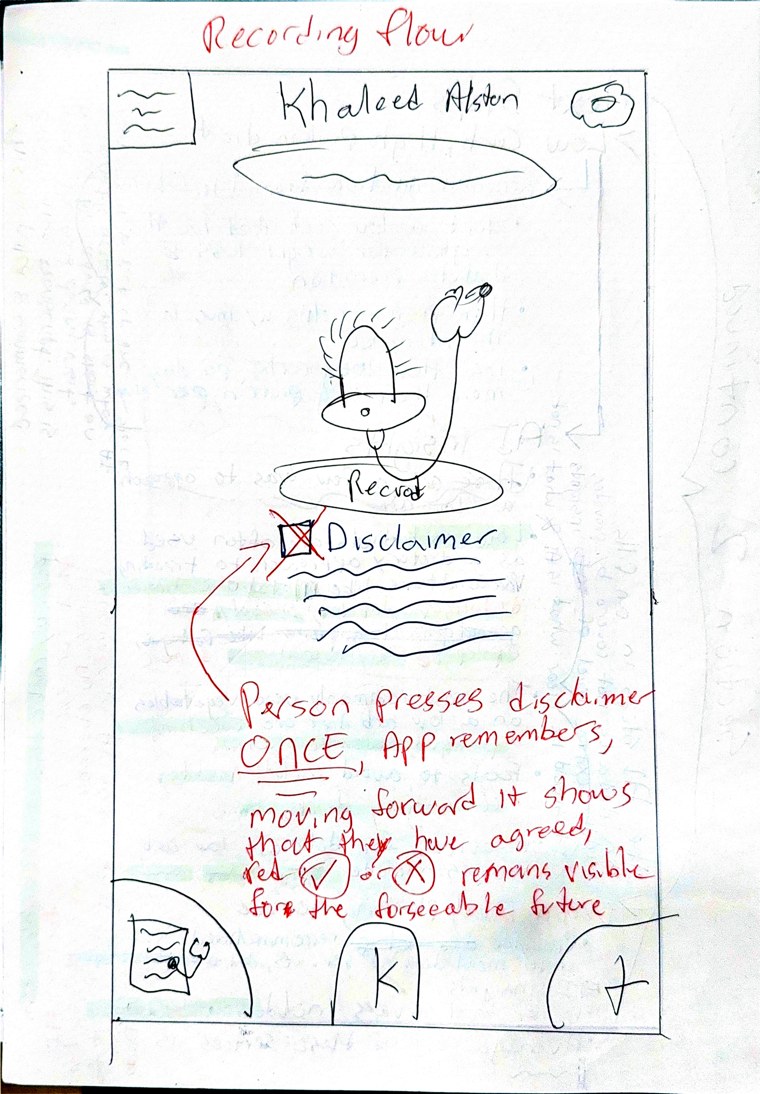
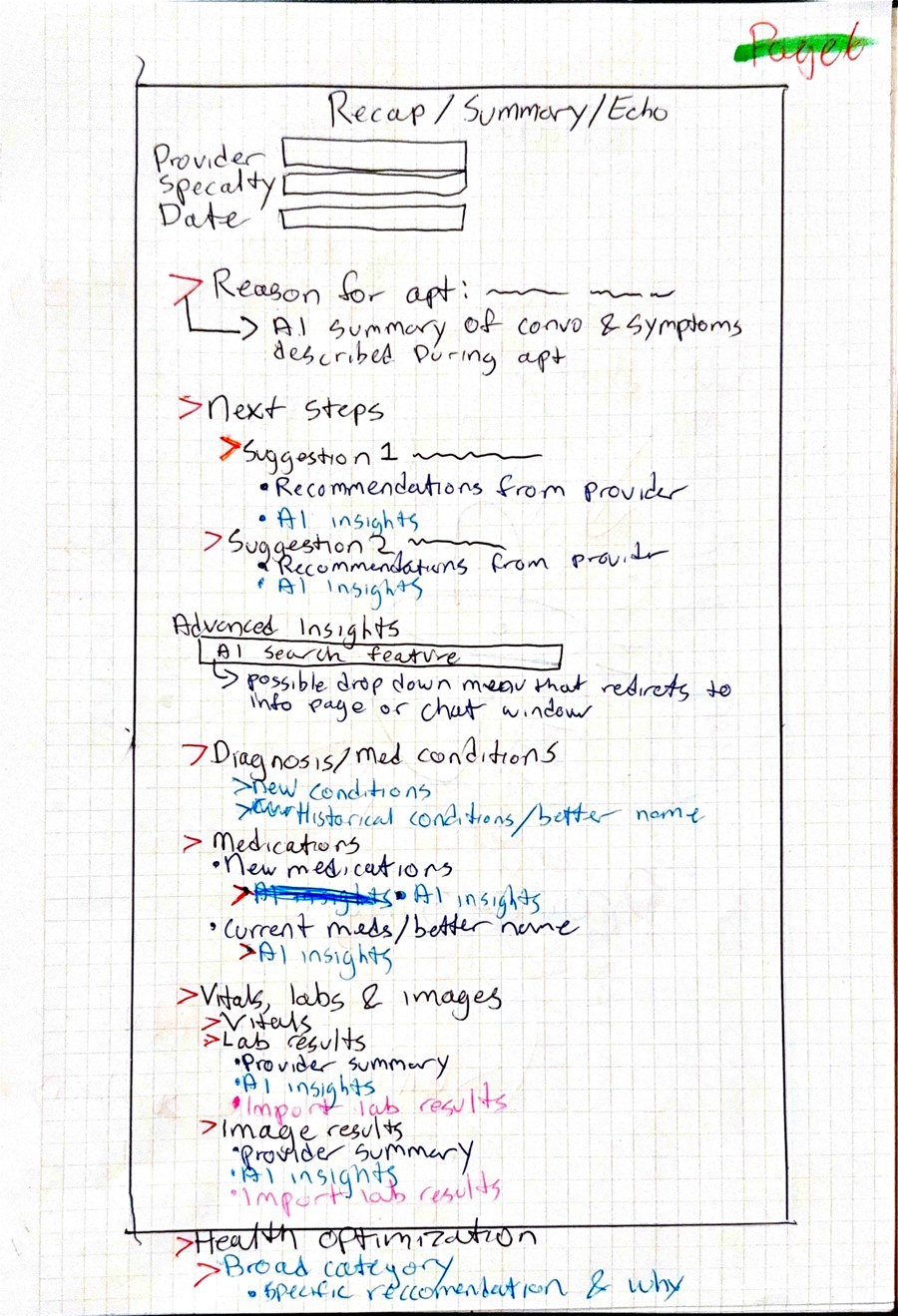
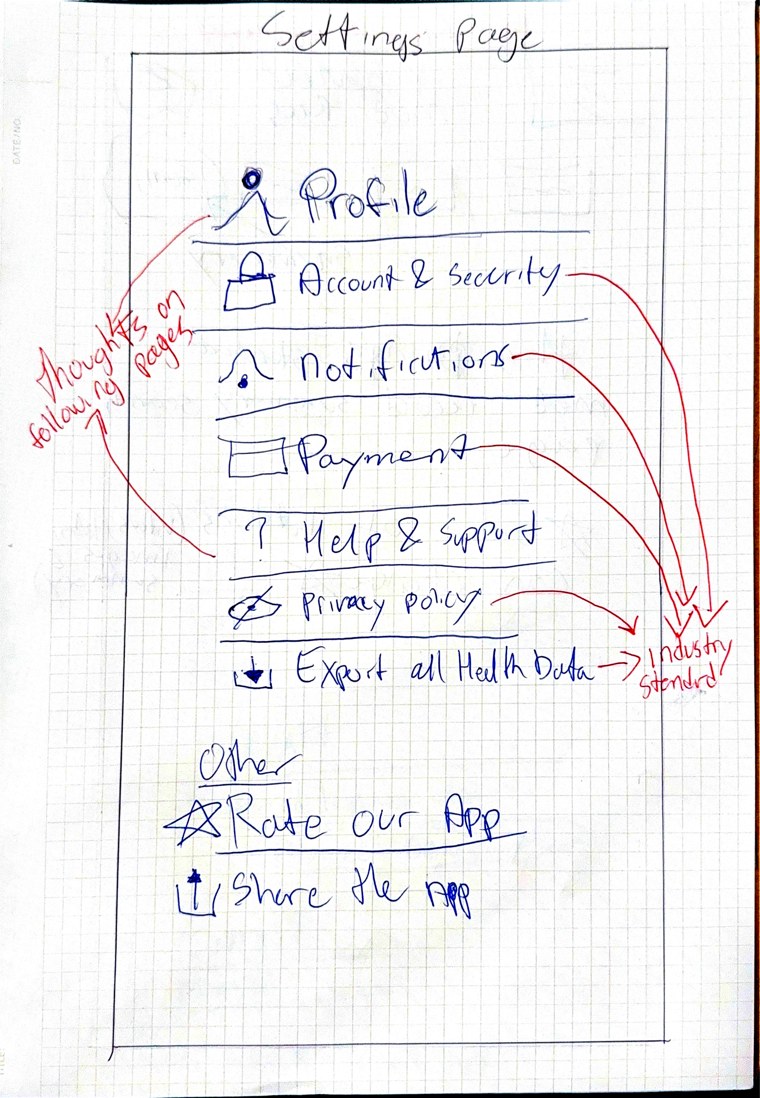
Left to right: my hand sketch, my wireframe, my hi-fi alpha design, and the screen the founder shipped on that foundation. They map almost one to one.
Not one screen — the entire app, from scratch.
I wireframed the full product: recording, the visit list, the after-visit summary, the medical record, sharing, history, and settings — the complete information architecture a lean, founder-led team could build against.
A hi-fi proof of concept he could put in front of people.
I took the wireframes to a full hi-fi visual design — a clickable alpha the founder could actually test with real users, not just imagine. Record and consent, the paused-recording state, the visit summary with AI insights, sharing, and settings, all in one coherent system.
And here’s the app he launched.

The founder’s shipped app — Doctors Notes by NuriQ— running in the App Store preview. Record a visit, get a plain-language summary, in English or Spanish. The bones are the foundation we set together.
What people say about it nowGreat app for staying on top of your health!
So beneficial for my family and our healthcare. I love that I can record all our visits with doctors and go back and review them. A total game changer for me as a mom.
What I have been looking for
Every time I’m at the doctor they talk a mile a minute expecting me to remember it all. This app does just that — a full breakdown of what was discussed and next steps.
Great app!
Easy to use, super helpful!
The foundation set in that first paper sketch carried all the way to a launched, well-reviewed product.
Compliance was a design constraint, not a legal afterthought.
Handling recorded medical conversations means HIPAA is in the room from the very first sketch. I embedded compliance into the architecture from the earliest stages — shaping how data was captured, stored, and surfaced — so privacy was designed in rather than retrofitted after a build that assumed it away. In healthtech, the constraint is the product.
Founding design is setting the foundation others build on for years.
The UX structure I set carried the product from Alpha through a closed Beta proof of concept to an App Store launch — and gave a lean, founder-led team the frameworks to keep building without a designer in every room. Being first in means your decisions compound; that’s the weight and the privilege of the founding chair.
No public adoption or revenue figures are quoted here — the concrete outcome is a shipped product (Alpha → Beta → App Store) built on the UX foundation I established.